 MHI Solutions Improving Supply Chain Performance

Protective guarding solutions are an essential component of creating and maintaining safe environments in a variety of industrial settings, helping to protect not only workers but the equipment, products and facilities themselves. Due to the vital nature of protective guarding, users need to have the utmost confidence that the solutions they choose are up to the tasks at hand.
With that in mind, the Protective Guarding Manufacturers Association (ProGMA) of MHI works diligently to help operators of industrial facilities navigate the wide range of protective guarding solutions and identify the ones that best fit their unique needs. Among those resources, ProGMA, which is comprised of lead suppliers and manufacturers of protective guarding solutions, has assembled a search tool of protective guarding tools, FAQs and a host of videos, case studies and blog posts that delve into the nuances of protective guarding and its many applications in the field.
ProGMA’s resources help those who run warehouses, distribution centers and other facilities analyze the financial value of different guarding tools and learn how to continuously evaluate guarding strategies to ensure the best and safest conditions possible.
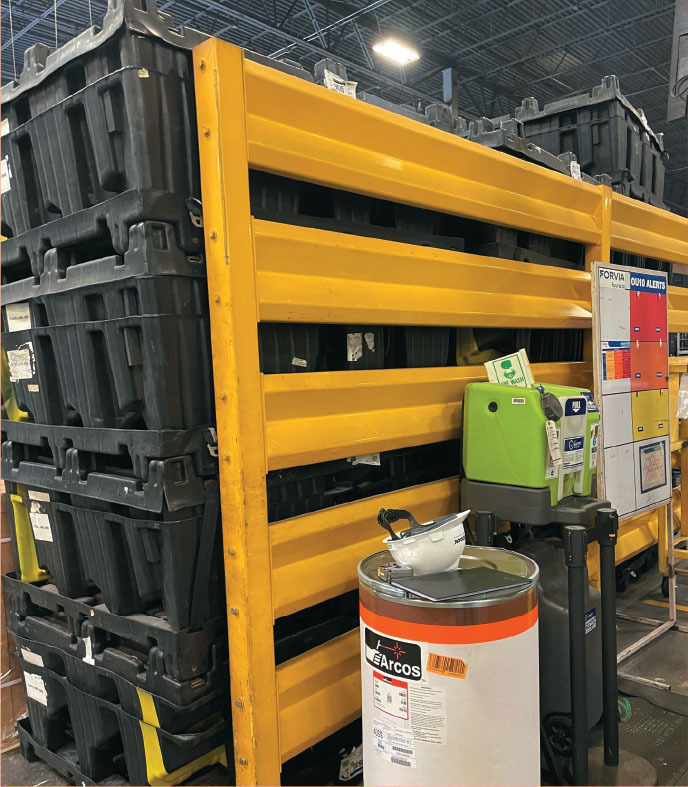
Topple barriers, such as this example from 4Front Engineered Solutions’ Tuff Guard line, are designed to catch products if they fall over. PHOTO PROVIDED BY 4FRONT ENGINEERED SOLUTIONS
“There are multiple protective guarding solutions available to protect employees from the risk of a workplace injury,” ProGMA Chair Ken Parrott, director of business development at MHI member Impact Recovery Systems, said. “Often, several different options exist to safeguard workers from dangerous interactions with equipment, machinery or other hazards. It can be challenging for operations managers to determine the ideal solution.”
The toolbox search tool, for instance, covers everything from bollards and column protectors to conveyor guarding and dock‑lift gates, ultimately capturing nearly 40 different types of equipment options. The tool not only shares different solutions but also gives detailed explanations for how they are used. ProGMA’s emphasis on user‑friendliness can be seen in the way the search function allows users to enter what the guarding will protect and then be shown a selection of product descriptions, images and manufacturers to be considered.
“By using the tool to search based on the application, a diverse range of protective guarding options appears,” Parrott said. “So, whether you need to protect a rack, a doorway or a robotic cell, for example, the tool will quickly display the different types of protective guarding equipment that would work.”
The range of ways that protective guarding solutions are deployed is always expanding and evolving to meet new trends and uses, and ProGMA’s resources help to track them for users of their offerings. For instance, among the notable retail consumer developments in recent years is the buy‑online‑pickup‑in‑store trend. However, the trend is not limited to retail, as a ProGMA blog post details. In fact, some business‑to‑business customers now pick up their purchases directly at warehouses. For warehouse operators who offer that option, it is essential to ensure a safe way for those items to be picked up. Self‑serve industrial lockers made with wire mesh panels are an effective option.
The lockers are set up in designated areas in an industrial facility with controlled access. Customers and carriers can access the lockers with or without assistance from employees. Wire mesh panels offer a steel frame and steel wire mesh with small openings, providing visibility and security, while solid metal panels can be used if an operator prefers to keep the items in each locker hidden. The lockers are only one of a variety of ways that wire mesh panels are used, ranging from securing the perimeter of powered equipment or machinery to keeping items from falling off industrial pallet racks.
ProGMA’s online resources also help users understand the standards that the group has developed to maintain consistency among manufacturers in product testing and give the end user a way to compare apples to apples when considering which solution to choose. The group has established standards for steel mesh containment panels used in vertical storage system applications, crash testing methods for industrial guardrail barriers and barrier posts, and test methods for topple barriers.