 MHI Solutions Improving Supply Chain Performance
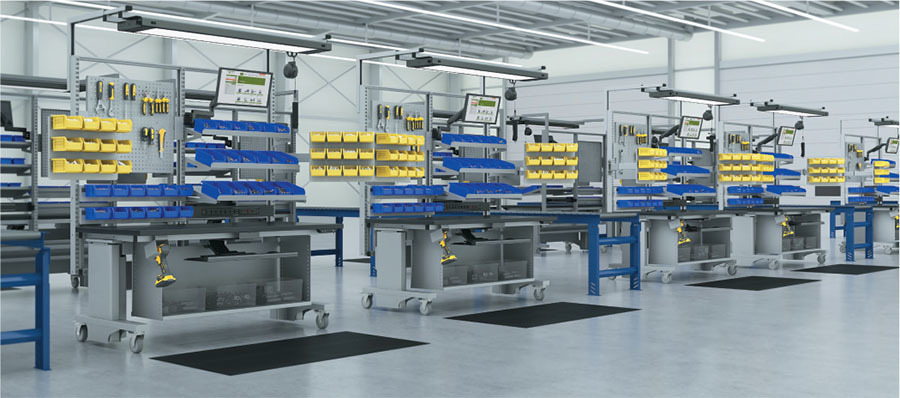
Ergonomic assembly workstations feature powered height adjustability, overhead lighting with tool track and balancer, adjustable monitor and keyboard supports for optimal ergonomics, and modular bin storage for supplies of various sizes. Tool holders and a pegboard complete the configuration. ALL PHOTOS PROVIDED BY BOSTONTEC
 AUTOMATION IS HELPING to create safer material handling workplaces. However, humans still play a vital role in these environments, and overlooking their involvement can create safety risks without proper care and oversight. That is especially true for ergonomic‑related risks.
“We know that it’s difficult to find talent today, so we have to keep the talent that we have as safe as we can,” Kelly Wehner, chair of the Ergonomic Assist Systems and Equipment (EASE) Industry Group in MHI, said.
Wehner said EASE members strive to correct the misperception that introducing automation to an environment means that an organization can relax its focus on ergonomics.
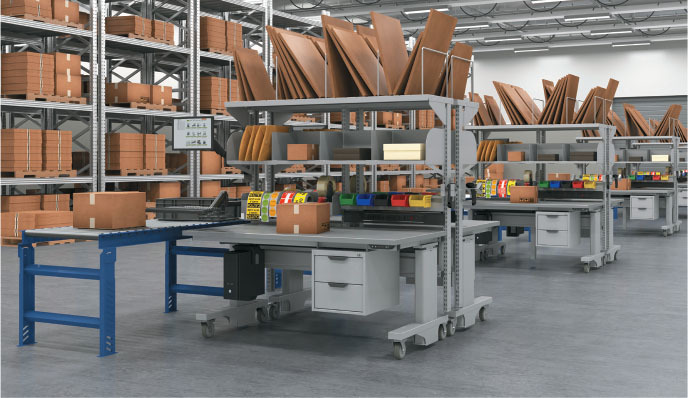
Ergonomic packaging workstations in a distribution center layout feature electric height adjustability, organized corrugate storage, a dedicated label trough and lockable drawer storage with adjustable PC components for efficient workflow support.
According to OSHA, musculoskeletal injuries, such as the sprains and strains common from ergonomic‑related motions, are among the most frequent injuries suffered in workplaces. OSHA notes that automation can help to reduce some of the repetitive tasks that lead to ergonomic injuries from manual labor but emphasizes that automation that is poorly implemented can create new ergonomic risks, such as a different set of repetitive motions.
“Automation could potentially create a negative safety situation,” Wehner said. “So how do we make sure that through ergonomics, with people engaged, we are setting that up so that we are taking that out of the mix? We need to make sure that we are leveraging both tools of ergonomics and automation for the best safety environment that we can for employees.”
As an example, Wehner pointed to a hypothetical internet fulfillment operation that features automation tools, such as a conveyor. Typically, conveyors that carry packages in environments like this one will have a stopping point on the line where a human will need to interact with the packages being transported at some point.
If the conveyor or worker’s workstation is at a fixed height, then it is not an “ergonomically sound” approach to the process for the workers, Wehner said. The workers at that location, after all, will be different heights, and if the conveyor or workstation cannot move up and down easily to fit the height and reach zone of each worker, then those workers inevitably will be using suboptimal repetitive motions for long periods that can lead to injuries.
“If we can’t align automation with that human interaction through whatever that piece of equipment is, then we lose,” Wehner said. “When automation is being planned, we have to make sure that if there’s something that is not automated within that flow, we have a solution for it.”
Among the keys to a successful marriage of automation and ergonomics is leadership that emphasizes it.
“The leadership of an organization from the top down has to send the message that our people are the most valued aspect of our organization,” Wehner said. “They have to make sure that they do the right thing and keep people safe in whatever operation they are performing. Once that mindset is institutionalized, anytime you go into a project, whether it’s automated or not, there needs to be a job assessment done about what are the ergonomic aspects of this particular operation.”