 MHI Solutions Improving Supply Chain Performance
ENERGY PRICES ARE significantly exposed to Cold War Two risks. The key takeaway for manufacturing and supply chain professionals is that the companies that insulated themselves by reducing their reliance on hydrocarbons ahead of the conflict with Iran to meet sustainability goals are poised to benefit asymmetrically in an environment of high prices and elevated risks.
OIL PRICES SURGED DUE TO CONFLICT
Oil prices surged sharply in March and April, following the onset of the U.S. conflict with Iran. In fact, the price increase has been among the fastest increases on record. At the retail consumer level, the rapid repricing of energy risk has sent AAA retail gasoline prices to $4.30 per gallon at the end of April 2026, up from $3.99 at the end of February 2026. This price was also sharply higher than $3.18 at the end of April 2025.
As a double‑edged sword, this fuel price shock threatens to compound upside inflation risks while also eroding consumer purchasing power, weighing on the growth outlook. The U.S. and global economic outlooks have darkened as a result of the conflict and higher oil prices. Growth risks are skewing downward, while inflation risks are moving higher. This is a stagflationary impulse driven by geopolitics.
The International Monetary Fund (IMF) reinforced this concern in its April 2026 World Economic Outlook, highlighting downside risks to growth and upside risks to inflation. Moreover, these risks are poised to compound the longer that this conflict persists.
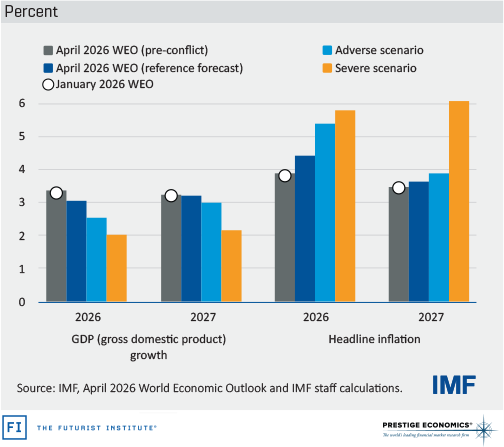
Downside Risks to Growth, Upside Risks to Inflation
The duration and scale of the conflict will shape the global outlook
SUSTAINABILITY AS A STRATEGIC HEDGE
While higher energy prices have historically been viewed as a headwind for global growth, they are now revealing a more strategic divide across companies and countries.
In an environment of geopolitical uncertainty, commodity supply chain risks and tail‑end energy risks, sustainability will be an increasingly valuable financial and strategic advantage.
Companies that invested in electrification, particularly electric vehicle (EV) fleets, are now experiencing a meaningful buffer against rising fuel costs. While gasoline and diesel prices surge, electricity costs have remained relatively more stable in many regions. That gap is translating directly into margin protection, especially for companies that have installed their own behind‑the‑meter renewable power generation.
Firms that reduced hydrocarbon consumption through electrification, increased efficiency, renewable energy integration or a mix thereof are less exposed to one of the most volatile inputs in the global economy.
The geopolitical climate of uncertainty shows that the future of sustainability will be about more than traditional environmental, social and governance (ESG) narratives. Increasingly, it is tied to resilience in a high‑risk world.
MORE OIL PRICE RISKS AHEAD
Most national security professionals frame the elements of national power in a DIME framework, which stands for diplomacy, information, military and economics. The weaponization of economic, energy and supply chain vulnerabilities is well underway—with more risks ahead. Future conflicts will be increasingly waged as economic wars, which is something we have seen in the Russian war with Ukraine and in the U.S. conflict with Iran.