 MHI Solutions Improving Supply Chain Performance
71% say AI is disrupting supply chains, with 24%
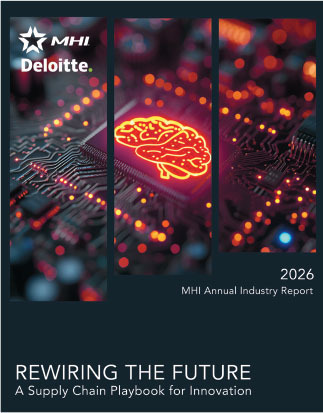
MHI AND DELOITTE recently released a report identifying artificial intelligence (AI) as the supply chain industry’s most disruptive technology for the next decade.
The 2026 MHI Annual Industry Report, “Rewiring the Future: A Supply Chain Playbook for Innovation,” finds that the emergence of AI is causing supply chain leaders to reassess every aspect of their operations, investing not only in advanced digital technologies such as AI, robotics and real‑time analytics but also in their workforce.
The publication, based on a survey of supply chain leaders, reports that a quarter of respondents (24%) categorize AI as transformational and nearly half (48%) consider its disruptive impact to be significant or greater—up 25 percentage points since 2025. Robotics and automation follow AI as the second‑most disruptive technology, with 39% rating its impact as significant or greater, up 16 percentage points.
By focusing on the intersection of business and technology, the report goes beyond tech trends to explore how operational assessments, smart automation, data‑driven decision‑making and new approaches to talent development can be woven together to “rewire” supply chain performance.
INNOVATION SPENDING PLANS
According to the report, 56% of organizations expect to increase their spending on supply chain innovation, with 52% saying they are planning to spend over $1 million. Another 17% plan to spend over $10 million. This spending reflects a more disciplined investment approach as companies are stepping back to confirm what problem they’re trying to solve, using stronger management and scenario-planning practices to better justify, control and scale technology investments.
Today’s supply chain organizations operate in an environment defined by relentless disruption, volatility and rapidly shifting market demands. Geopolitical uncertainty, labor shortages, accelerating technology cycles and elevated customer expectations have converged to make predictability a thing of the past. Strategic priorities now include strengthening risk management, enhancing transparency, enabling rapid fulfillment and embedding sustainability throughout the supply chain.
AI IS THE FUTURE OF SUPPLY CHAIN—AND THE FUTURE IS NOW
AI is already adding value in a wide range of supply chain processes, from inventory management to demand planning to logistics. Moving forward, supply chain organizations will increasingly leverage AI to enhance all aspects of their operations. Agentic AI specifically has the potential to quickly eliminate high‑volume repetitive tasks, proactively address disruptions, enhance forecasting precision and improve overall visibility within the supply chain.
While leaders are excited about AI’s potential, the report finds that they are getting stuck on where to start and what it takes to scale. The barriers are real and practical—unclear use cases and automation cost, paired with limited understanding; difficulty building business cases; talent shortages; and budget constraints.
The integration of generative AI, agentic AI, physical AI and edge AI is reshaping fulfillment and supply chain operations, enabling more adaptive and intelligent decision‑making. This transformation does not just improve existing processes; it fundamentally changes how challenges are solved, how capital is invested and how workforce capacity is harnessed.
UNCERTAINTY TOPS THE LIST OF KEY TRENDS IMPACTING SUPPLY CHAINS IN 2026
According to this year’s respondents, these are the top trends impacting supply chains:
- Economic Uncertainty, Inflation and Geopolitical Risks
- Workforce, Talent Shortage and Changing Worker Skillsets
- Pace of Technology Adoption, Digitization and the Need for Real‑Time Data
- Supply Chain Visibility, Agility and Resiliency
- Cybersecurity and Data Security
- Rising Cost of Capital
- Inventory Challenges
- E‑Commerce Growth
- Customer‑Centricity
- Reshoring
The report also provides real‑world case studies of digital supply chain technologies and recommendations for leaders to develop strategies to implement these innovations.
Download the complete report at mhi.org/annual‑industry‑reports.