 MHI Solutions Improving Supply Chain Performance
 The 2026 MHI Annual Industry Report findings underscore that supply chains can no longer evolve incrementally. To compete in an era defined by volatility, organizations must integrate artificial intelligence, automation and workforce strategy into a cohesive, scalable operating model.
WITH THE RAPID emergence of artificial intelligence (AI), supply chain leaders have arrived at a breakthrough moment.
According to the 2026 MHI Annual Industry Report, “Rewiring the Future: A Supply Chain Playbook for Innovation,” today’s operations continue to be shaped by a convergence of pressures. Among them: economic uncertainty, labor shortages, rising customer expectations and accelerating technological change. In response, organizations are moving beyond isolated improvements and increasingly turning to AI as a means to achieve a more fundamental transformation—what the report describes as “rewiring the supply chain” end‑to‑end.
“Supply chains can no longer be optimized at the edges,” John Paxton, CEO of MHI, said. “Leading companies realize their supply chains must be rewired end‑to‑end. Only connected, intelligent and automated real‑time networks will withstand the volatility and meet future customer demands for speed and efficiency. AI gives them the opportunity to combine both software and physical systems to pull everything together.”
Paxton made his remarks during a MODEX keynote presentation on April 15, during which the latest report was released. Researched and written by MHI and Deloitte for the past 13 years, the new report offers insights into emerging disruptive technologies and innovations driving supply chain transformation worldwide. It joins all of MHI’s previously published annual industry reports as a free download at mhi.org/annual‑industry‑reports.
The 2026 report was informed by survey responses received in December 2025 from more than 500 supply chain leaders across a broad assortment of industries, noted Paxton.
“Participating companies range from small to large, with 51% reporting annual sales in excess of $50 million and 18% of $1 billion or more. Participants with the titles of CEO, president, vice president, SVP, director, general manager or department head provided 61% of the data,” he said. “That gives us key insights into the supply chain strategies from a leadership perspective.”
The report’s findings reflect a decisive shift among supply chain leaders’ strategies surrounding innovations and investments, Paxton continued.
“Competitive advantage will no longer come from adopting technology alone, but from how effectively companies scale, integrate and operationalize it,” he noted. “Today, the biggest threat supply chains face isn’t disruption. It’s the failure to innovate and the risk of running tomorrow’s operations on yesterday’s equipment and technology.”
That shift is not theoretical. It is already underway, agreed Wanda Johnson, supply chain technology fellow at Deloitte Consulting. Johnson again returned to lead the research behind the report.
“The report’s findings emphatically indicate that AI is shifting supply chains from static, schedule‑driven execution to much more dynamic, real‑time orchestration,” noted Johnson. “Supply chain leaders are seizing the opportunities that AI can deliver. Those who connect operational excellence, AI‑driven orchestration and workforce readiness into a single playbook will not just withstand disruption. They will convert it into sustained performance and growth.”

As with prior reports, the release of the 2026 MHI Annual Industry Report was accompanied by a MODEX keynote panel discussion. Moderated by Johnson, four panelists offered insights, context and perspective on its findings. They included:
- Camille Blake, regional director of logistics at Carvana
- Fredrick Cox, director of manufacturing at Central Shops at Walt Disney World
- Andrew Rice, senior technical product manager of warehouse management systems at Gallo
- Stephanie Thomas, associate professor of practice of supply chain management at the University of Arkansas’ Sam M. Walton College of Business
The keynote panel focused on tactical steps for successfully achieving end‑to‑end supply chain orchestration, strategies for applying AI to yield insights and the critical importance of change management as part of digital technology deployments.
THE INFLECTION POINT: FROM ADOPTION TO EXECUTION
For years, digital transformation in supply chain has centered on experimentation: pilots, proofs of concept and emerging technologies. According to the report, that era is ending.
Today, the challenge is execution. While interest in AI, automation and advanced analytics continues to surge, many organizations are struggling to translate that interest into measurable operational results. In fact, the report highlights a widening “execution gap,” where companies invest in innovation but fail to scale it across the enterprise.
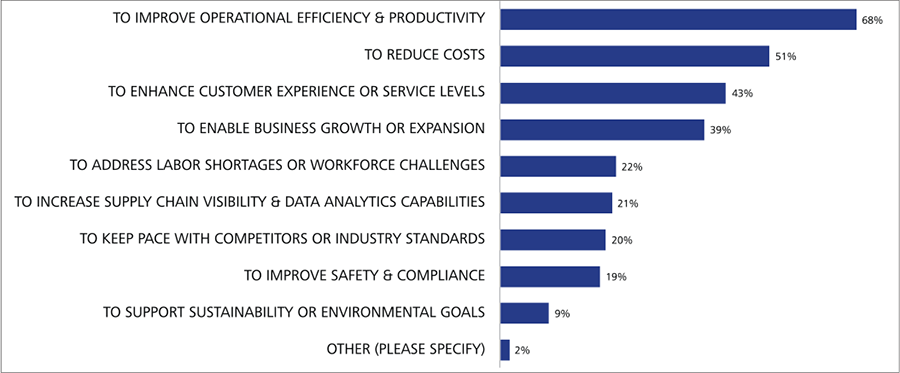
This shift is reflected in investment trends, continued Johnson.
“After peaking in 2022‑2023, spending on supply chain technologies has normalized. Organizations are now prioritizing return on investment (ROI)‑driven initiatives over large‑scale, speculative transformations,” she said.
At the same time, investment strategies are becoming more disciplined, added Johnson, pointing to three key survey findings:
- 56% of organizations plan to increase supply chain innovation spending
- 52% expect to spend over $1 million
- 17% plan to invest more than $10 million
“Notably, this spending reflects a more deliberate approach. Companies are stepping back to define problems clearly, build stronger business cases and use scenario planning to justify and scale investments,” she explained.
AI TAKES CENTER STAGE AS THE TOP DISRUPTOR
Among all emerging technologies, one stands above the rest: AI. The report identifies AI as the most disruptive force shaping supply chains over the next decade.
- 71% say AI is already disrupting supply chains
- 48% cite its impact as significant or greater (up 25 points year‑over‑year)
- 24% classify AI as transformational
AI adoption is also accelerating rapidly, with 88% of organizations expected to implement it within five years, making it the top technology investment priority.
That influence is already visible across key use cases:
- 33% are using AI to enhance demand forecasting and inventory optimization
- 30% are applying it to predictive maintenance
- 27% are automating operational decision‑making
- 26% are optimizing logistics and transportation routes
- 24% are streamlining purchasing processes
And yet, adoption remains uneven. Nearly 28% of organizations are not yet leveraging AI, underscoring both the opportunity—and the risk.
“At Carvana, AI is used extensively for data analytics and process optimization,” reported Blake. She suggested that other organizations looking to integrate AI into their operations first identify standardized and predictable high‑volume tasks to streamline the adoption process.
In sharing an example, she remarked that Carvana has seen significant success integrating these tools into the customer experience.
“As noted in our recent shareholder reporting, last year 30% of Carvana customers who purchased a vehicle—and 60% of those who sold to the company—completed their journey without needing human interaction until the final driveway transaction,” noted Blake. “Leveraging AI for data analytics and process optimization is what has allowed our company to reach that level of scale.”
Such applications signal a broader shift from static, reactive operations to dynamic, AI‑driven, intelligent orchestration. Rather than relying on fixed workflows, leading organizations are deploying systems that can sense disruptions, simulate outcomes, make decisions and continuously learn. This “sense‑decide‑execute‑learn” loop is becoming the foundation of modern supply chain management.
The next frontier is agentic AI systems, which are capable of acting autonomously with human oversight—known as “human‑in‑the‑loop (HITL)” collaboration. These technologies can eliminate repetitive tasks, anticipate disruptions and enhance real‑time visibility across the supply chain.
AUTOMATION ACCELERATES—BUT NOT WITHOUT CHALLENGES
If AI is the brain of the modern supply chain, automation is its muscle. Robotics, autonomous vehicles, wearables and advanced material handling systems are rapidly transforming warehouse and manufacturing operations. These technologies enable faster fulfillment, improve accuracy and reduce reliance on manual labor.
Robotics and automation rank as the second most disruptive technology, with:
- 39% citing significant impact (up 16 percentage points)
- 73% expecting adoption within five years
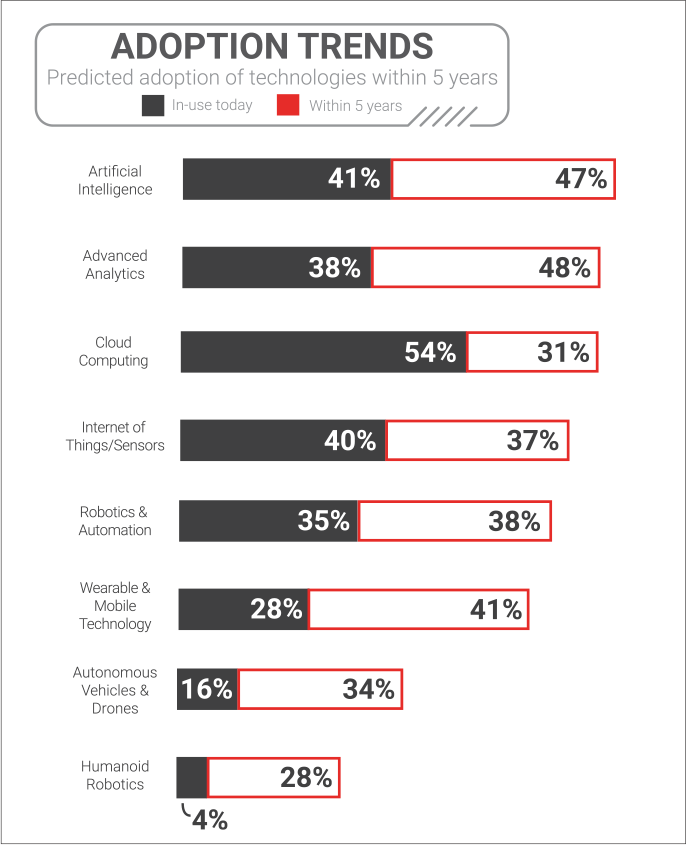
Other fast‑growing technologies include:
- Advanced Analytics: 86%
- Cloud Computing and Storage: 85%
- Internet of Things (IoT)/Sensors: 77%
- Wearables and Mobile Technology: 69%
- Autonomous Vehicles/Drones: 50%
- Humanoid Robotics: 32%
Despite strong momentum, implementation challenges persist. Workforce constraints, high capital costs, integration complexity and long deployment timelines continue to slow progress. Many organizations also struggle with where to begin or how to build a compelling business case.