 MHI Solutions Improving Supply Chain Performance

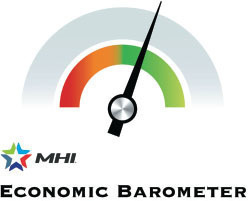
THE U.S. ECONOMY is facing two conflicting dynamics with a rare coexistence of momentum and uncertainty. Gross domestic product (GDP) growth has been much better than many expected, and the U.S. labor market remains relatively tight. Meanwhile, U.S. inflationary pressures have eased meaningfully, although year-on‑year rates remain above the Fed’s 2% target. At the same time, however, geopolitical risks and trade uncertainty loom large, shaping a business environment where opportunity and risk are expanding in parallel.
GROWTH IS STRONG AND BROADLY SUPPORTED
Economic growth has been resilient. U.S. GDP expanded at a robust 4.4% annualized pace in the Q3 2025 revised report, underscoring the economy’s capacity to grow even after a historic tightening cycle typified by rapidly rising interest rates and a shrinking Fed balance sheet. Plus, the growth outlook remains constructive not just for the U.S., but globally, according to the latest International Monetary Fund World Economic Outlook from January 2026. Lower interest rates across economies, as well as increased defense spending among the U.S. and its military allies in Europe and Asia, are also supportive of growth and the global economy. A solid growth outlook is crucial for globally exposed sectors, supply chains and capital investment decisions, as synchronized growth tends to reinforce demand across regions.
THE LABOR MARKET REMAINS TIGHT
The labor market is the core pillar of U.S. economic strength, as more than 69% of Q3 GDP came from consumption. Fortunately, despite a rise in the U.S. unemployment rate in 2025, the labor market remains supportive of growth.
The U.S. unemployment rate averaged 4.3% in 2025, which was well below the 5.6% average since January 2020. Even more striking is the imbalance between labor demand and supply.
Throughout 2025, there were well over 7 million open jobs, while total jobless claims averaged roughly 1.9 million. That implies that there were 5 million more job openings than people collecting unemployment on average throughout the year. This gap underscores the strength of the U.S. labor market, despite slowing nonfarm payrolls in 2025. It also reveals the operational challenges facing employers, from wage pressures to productivity constraints. These challenges have been extremely pronounced for industries trying to fill physically demanding in‑person roles, including material handling, manufacturing, construction and health care.
INFLATION IS A LIMITING FACTOR FOR FED INTEREST RATE POLICY
Inflation remains elevated relative to pre‑pandemic norms, but the trajectory has been decisively lower. In the wake of the COVID pandemic and the Russian War on Ukraine, average year‑over‑year Consumer Price Index (CPI) peaked at 8.0% in 2022, eased to 4.1% in 2023, slowed further to 3.0% in 2024, and declined again to 2.6% in 2025. This disinflation trend has been critical in restoring purchasing power and stabilizing planning horizons for businesses and households alike. However, because consumer inflation remains above the Fed’s 2% target, the Fed is unlikely to lower rates rapidly or more significantly, unless the economic and labor markets change significantly.
MONETARY POLICY IS NOW A TAILWIND
As inflation pressures have moderated, monetary policy shifted from restraint to support. The Federal Reserve cut its policy rate from an upper bound of 5.50% at the end of 2023 to 4.50% by the end of 2024, and then to 3.75% by the end of 2025. While rates remain above the ultra‑low levels of the prior decade, financial conditions are meaningfully easier.
Looking ahead, interest rates are likely to drift somewhat lower over the next two years. Combined with a weaker U.S. dollar, this environment of lower interest rates is supportive of growth, capital investment and interest‑rate‑sensitive sectors, including material handling, logistics and industrial activity more broadly.
Click here to read the full article.