 MHI Solutions Improving Supply Chain Performance
The group works to clarify mobile automation’s real capabilities while supporting safer, smarter adoption.
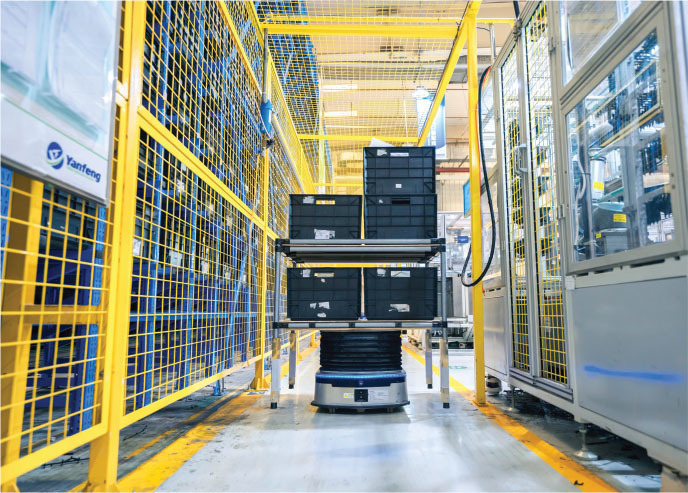
An automated guided vehicle moves a bus frame through an assembly area. PHOTO PROVIDED BY ALIGN PRODUCTION SYSTEMS
 MEMBERS OF MHI’S Mobile Automation Group (MAG) are eager to share the latest innovations in automated guided vehicles (AGVs) and autonomous mobile robots (AMRs)—and to dispel some common myths.
“People are looking to move things very quickly, easily, 24/7—and automation is the premier solution to help them do that,” Holly Hale, MAG’s co‑vice chair and marketing manager for MHI member Align Production Systems, said.
AGVs are built to follow a predefined path, while AMRs follow an “in the moment” path, with different sensors enabling them to roam freely through a facility, Hale said.
“Safety is always at the top of mind for any plant or facility because we need to be able to move things in a safe and easy way—and with the technology around sensors, LiDAR and cameras developing on AGVs and AMRs, they really are safe solutions,” she said. “You can rely on that piece of equipment to go where it’s supposed to go, and when it’s supposed to go.”
The industry group has produced a series of online training modules, MAG 101, covering both the basics and advanced topics, Hale said. The modules are intended for anyone looking to learn more about automation, as well as employees of member companies new to the industry.
Additional educational efforts include blogs, articles and podcasting—”we’re just trying to educate the broader audience about automation,” she said.
MAG is particularly interested in reaching out to the younger generation, including providing scholarship opportunities for people looking to enter the industry.
“We have a booth at Skills USA with MHI, educating people who are new and upcoming in this industry, letting them know that we’re a resource for them to learn more,” Hale said.
Potential end‑customers benefit from having MAG—”a trusted resource at their hand”—that provides education, guidelines and links to the industry group’s members for project inquiries, Kai Beckhaus, an independent consultant based in Houston, said.
MAG has also launched a sub‑committee looking into standardization, Beckhaus said.
“There are a lot of different standards that are being generated by different standardization bodies,” he said. “It is difficult for the end‑user to understand what standards apply, and if they are mandatory or optional. Thus, we want to guide the user as well as over the course of time influence the standardization to represent and promote the safe use of AGVs and AMRs.”
Internally, MAG members benefit from the MHI statistics program where everyone submitting their statistics receives anonymized data back that enhances their market intelligence, Beckhaus said.
MAG also seeks to educate MHI members and practitioners about the realities of mobile automation and help dispel some of the myths—like “the marketing hype” that mobile automation is going to replace conveyor, Matt Bush, MAG’s co-vice chair and vice president, technology, innovation and research at MHI member KPI Solutions, said.
“I think there’s always going to be applications best suited for conveyor and, conversely, there will be applications where mobile automation is justified,” Bush said. “Depending on the problem a company is trying to solve, their appetite for new tech and their timeline and budget, mobile automation may help a company solve their pain points.”