 MHI Solutions Improving Supply Chain Performance
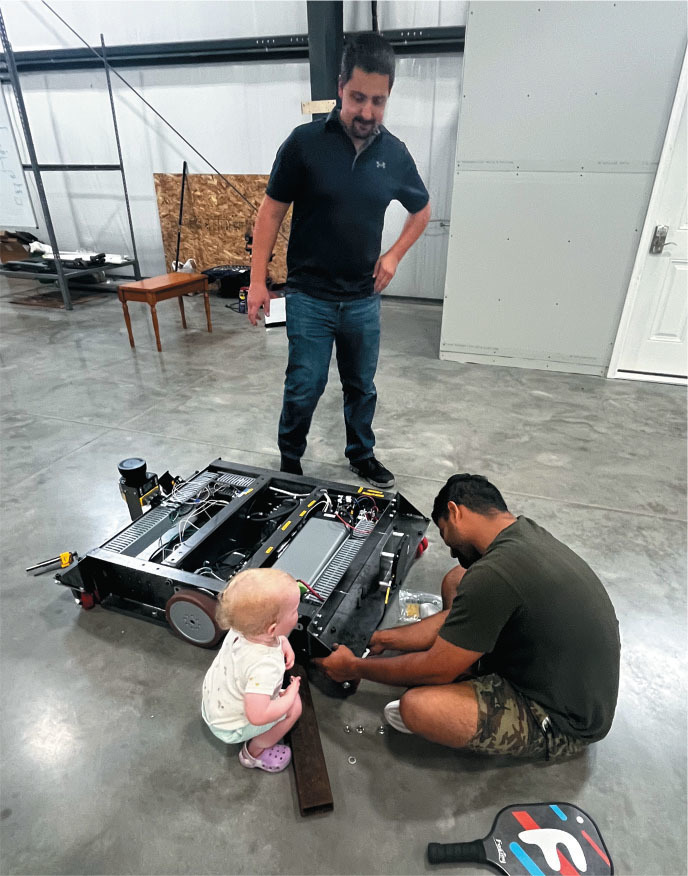
USAMR co‑founder Shiva Sundaram shows Sadie Saur, daughter of co‑founder Nick, the USAMR robot while controls engineer Jonathan Dobbs watches.
“The idea of shelf‑to‑goods and shelf‑to‑person is not new,” he said. “The technology was proven by Amazon. Then the rest of the U.S. caught on. China took the market by storm.”
But Saur’s experience as an automation integrator left him with a front‑row seat to the chaos behind the curtain. “I was integrating the best of the best technology in mobile robots. It was quite a dumpster fire behind the scenes.”
The biggest problem, he said, wasn’t the robots. It was the support.
“When you need a change, support, spare parts or just someone to talk to figure out how to best do something, it’s almost impossible,” Saur said. “All the big players in the game have identified that customer service is an issue. We are going to be customer‑centric where none of our systems or customers will be left high and dry. They’ll have 24/7/365 customer care here in the U.S.”
That commitment is tied to another differentiator: U.S.‑based manufacturing and U.S.‑built software. “A lot of the value proposition is that we are made here in West Michigan,” Saur said. “We are developing the software that manages the fleets in tandem. It’s an organic solution, not some company in the U.S. with software trying to adapt to foreign hardware. There’s often a miscommunication between those, from country to country.”
For Saur, the goal is a robot that feels familiar to the American workforce—durable, repairable and built with practical sensibilities. “We’re a team of industry experts on mobile robot technology. We’re applications‑focused first and roboticists second,” he said.
The U.S. base solves another issue of security, he said. Customers “want to know where their data is going and [that it’s]not going to a foreign entity. The biggest benefit is that the solution is developed in tandem to be everything that the American logistics company expects—robust, quality parts, quality manufacturing, fixed with a craftsman wrench and duct tape because the workforce in America is blue‑collar. You don’t need a German engineering degree to fix one of our robots.”
QUALITY OVER PRICE—AND THE ROI CASE
Saur is unapologetic about where USAMR sits in the market. “We are not competing on price. It was never a notion that I had,” he said. “With quality comes price.” The challenge, he admits, is helping customers understand the long‑term value. “The trick right now is to convince customers that it’s a buy once, cry once. You buy quality.”
Downtime, he notes, is where the real cost lies. “For some, it’s $50,000 a minute or $5 million an hour. It’s critical that we have systems that are redundant, scalable and flexible. All those things are true qualities that USAMR exhibits to be successful. The bar is low, but we don’t just walk over the bar.”
BUILDING THE TEAM TO BUILD THE ROBOT
Saur built USAMR by reaching out to trusted experts who “had the right knowledge set and in the area that I don’t,” he said.
His co‑founder is a mechanical engineer Saur met 14 years ago during a Michigan Tech senior design project who brings deep automation experience from both the U.S. and India. A longtime software collaborator leads development of the fleet management platform, “using all of our lessons learned to make sure we’re capturing all the heartache and the pain of the customer.” An industry veteran handles solutions architecture and technical sales, while a highly creative controls engineer rounds out the group.
“If I was going to build a team, it was with the best of the best,” Saur said. “They have the knowledge and capacity of what we need it to be.”