 MHI Solutions Improving Supply Chain Performance
How Physical Artificial Intelligence and Data‑Driven Robots Will Transform Warehouse Logistics
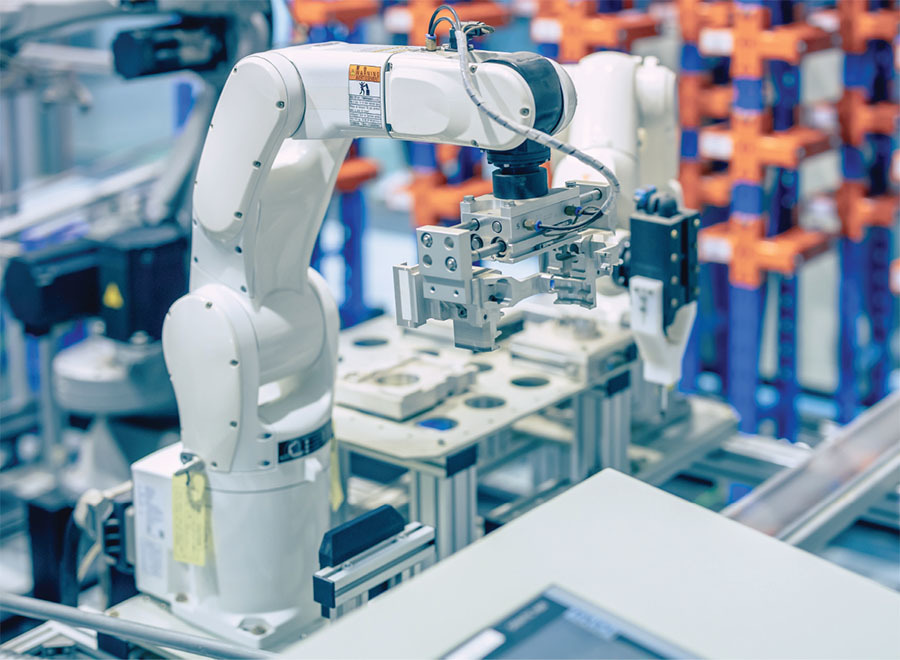
THE EVOLUTION OF robotic technology and artificial intelligence (AI) ‑driven warehouse management systems has paved the way for the next step in warehouse automation: physical AI. With physical AI, advanced technology can interact directly with the physical world through equipment such as robots, drones and autonomous vehicles.
Unlike traditional robots, physical AI systems are not limited to performing specific tasks in a predetermined way. Physical AI systems use sensory inputs to perceive their real‑world environment and gather data. Trained to reason using large language models (LLMs), they can make decisions and act on them using motors, grippers and wheels. They can learn from these decisions and then adapt their behavior to changing conditions in the real world. Although today there is usually a human in the loop in this process, the goal is to have the robots work without any direct human intervention one day.
In the world of physical AI, autonomous forklifts can determine, on their own, the best route for moving pallets around the warehouse. Robots can use their computer vision and tactile sensing ability for more complex picking and packing tasks. Robots can be connected through a network so that if one fails, another can take over its task.
PHYSICAL AI IN ACTION
Current warehouse management systems can track product locations within a facility, manage orders and monitor input and output rates. However, they still require a person to carry out commands.
“The real unlock with physical AI is that you actually allow the AI to do the interactions in the physical world, to take care of that work for you so you don’t have to rely on people,” Teddy Ort, senior vice president, Robotics Software & AI at MHI member Symbotic, said.
With physical AI, tasks can be approached more holistically, Ort said. A person building a pallet typically looks for a pattern that is reliable and quick to assemble. But with the right data, a physical AI system could decide how to shape the pallet to maximize space in the truck and even build it according to the store’s layout, making unloading more efficient.
“A person would just get completely overloaded with information,” Ort said. “But that’s a place where AI really excels, because it takes advantage of thousands of cores of processing. It can plan these things, can easily absorb all this information and spit out a pallet plan that takes into account factors that a person would never be able to handle.”
MHI member Locus Robotics combines physical AI with agentic AI in its LocusONE warehouse ecosystem. “On the agentic AI side, it delivers predictive analytics, dynamic task allocation and intelligent orchestration across fleets,” Oscar Mendez, director and head of AI & Data Science at Locus Robotics, said. “On the physical AI side, our robots provide adaptive navigation, simultaneous localization and mapping (SLAM) and 3D world understanding, along with specialized modules for grasping and collision avoidance.”
The agentic AI can predict future outcomes and act proactively. Robots receive tasks based on real‑time volume changes and operational priorities to ensure optimal throughput. They can plan routes through the warehouse without fixed paths, dynamically rerouting around obstacles or even predicted congestion, while maintaining efficiency, Mendez said.
BUILDING TRUST
Chris Coote, director of product at MHI member Dexory, said the full implementation of physical AI will be a transition from intelligent to adaptive warehouses. In today’s intelligent warehouses, AI processes data collected from autonomous robots, the warehouse management system (WMS) and other sources, and makes recommendations to humans who determine the best course of action. The AI removes the cognitive load of finding the problem, analyzing it and then coming up with a suggestion.
In the adaptive warehouse, AI agents use this information to make decisions and act in real time with minimal human input. Initially, these agents will be deployed on small jobs, such as deciding the best consolidation options for specific products to save warehouse space. The success of these initial efforts will be essential in gaining support for broader adoption of the technology.
“We have to build trust so that when we get to this world where we can deploy agents around some of these tasks, we’ve proven in depth that what the AI says will happen will come true,” Coote said.
Tim Gaus, principal and smart manufacturing leader at MHI member Deloitte, said most of his clients have the AI agent making recommendations and the humans making the final decision. “People are getting to trust very quickly with the human in the loop…I would say the quicker you get to having the technology prove itself, the more quickly you’re going to get to trusting it to do things independently, without the human in the loop,” he said. The degree of trust will also depend on the task. It’s a lot easier to trust an AI report on key stats from the last shift than it is to allow it to trigger an automated update of the speeds of conveyors.
DATA‑DRIVEN SUCCESS
Physical AI requires a large amount of data about the warehouse environment. Dexory’s autonomous robots scan up to 10,000 pallet locations per hour, capturing physical stock data and validating it against system records. Symbotic’s bots are each equipped with nine cameras as well as proprioceptive sensors that touch items to determine what they “feel” like. Light Detection and Ranging (LiDAR) provides depth perception.
“We’ll take a picture of every case that comes into the warehouse, but once the robots are handling the case, they’re also going to rely on another form of information: what the case feels like,” Ort said. “Is it the same size when I squeeze it as I would expect from the camera image?”
When processed by the AI, sensory data provides new insights into warehouse operations. For example, with collected information about how fast robots’ wheels are spinning throughout the warehouse, the AI could determine that the wheels of several robots in a certain area appear to be slipping. It could then notify the on‑site team to look for a spill or another issue.
“Over time, these data‑driven systems are expected to connect with other parts of the supply chain, such as truck arrival schedules and transportation platforms, so warehouses can automatically reprioritize tasks when shipments are early, late or especially urgent,” Akhil Docca, senior product marketing manager for robotics at NVIDIA, said.
Data readiness will be a major factor in the successful implementation of physical AI. “I think the completeness, timeliness and accuracy of the data are three things that warehouse operators should be asking themselves across all parts of data sources they have in the business,” Coote said. “All of this is built on having good quality data that you can interpret to give a good signal for insights and actions.”
DIGITAL TWINS
The data collected for physical AI can be used to build a digital twin of the warehouse. “The digital twin is where all of the information comes together,” Coote said. “It’s designed to be a real‑time snapshot of what’s occurring in the warehouse—a digital representation of the exact physical thing that’s on the floor.”
A digital twin enables analysis of different scenarios, such as the impact of introducing a new product line on slotting in the warehouse. Digital twins also enable the training of robots before they’re deployed in the physical world.
For example, the production line at Deloitte’s smart factory in Wichita, Kansas, has been simulated and used to train a robot arm. “We wanted to train it so that if something got in the way of the arm, it would automatically stop,” Gaus said. “We didn’t want to put a person in the way. We want to have a virtual person there. That helps de‑risk and really accelerate the ability to deploy this next wave of AI within the robotic space.”
Robots trained in a digital twin of a warehouse can practice numerous picking, routing and loading scenarios before touching the actual floor, Docca said. “Once deployed, they send back real‑world performance data, such as error rates and task times, which is fed back into the digital twin to continually refine workflows and routing strategies. This can lead to robots automatically avoiding crowded aisles during peak hours or reordering pick sequences to cut walking distance and speed up shipping.”